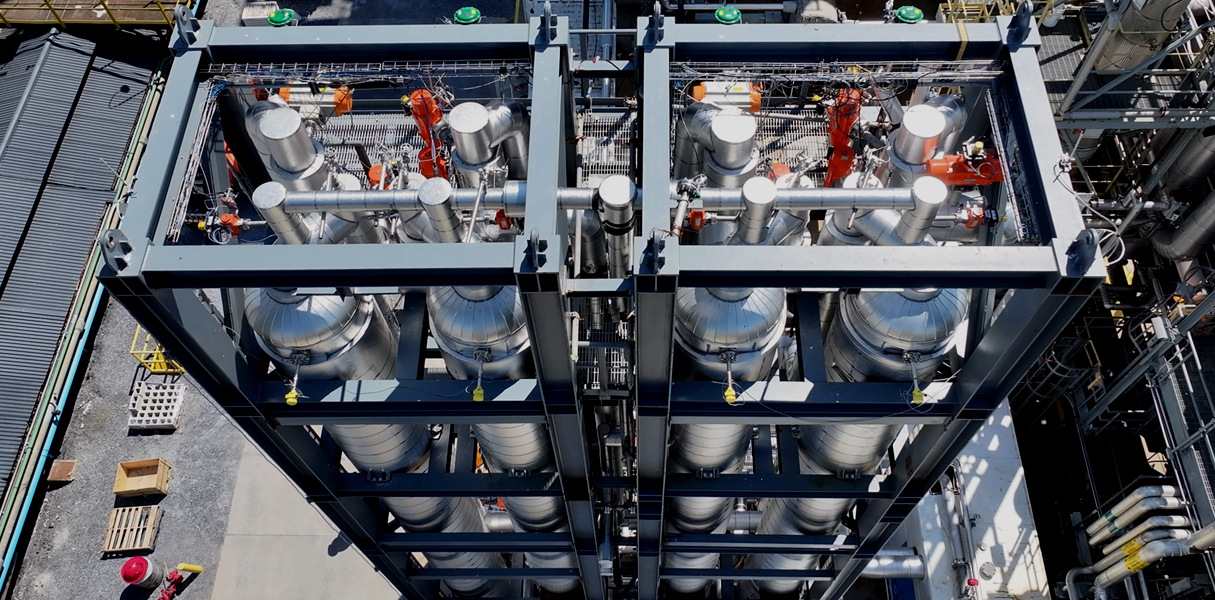
FrostCC® Cryogenic Carbon Capture.
Fully electric. No solvents. No steam.
A breakthrough in carbon capture performance validated through six years of R&D and thousands of hours of operational testing, applicable from natural gas combustion through industrial CO₂ concentrations. Expected to be the lowest levelized cost of all technologies with numerous other benefits.
HOW IT WORKS
Simpler Than You Think
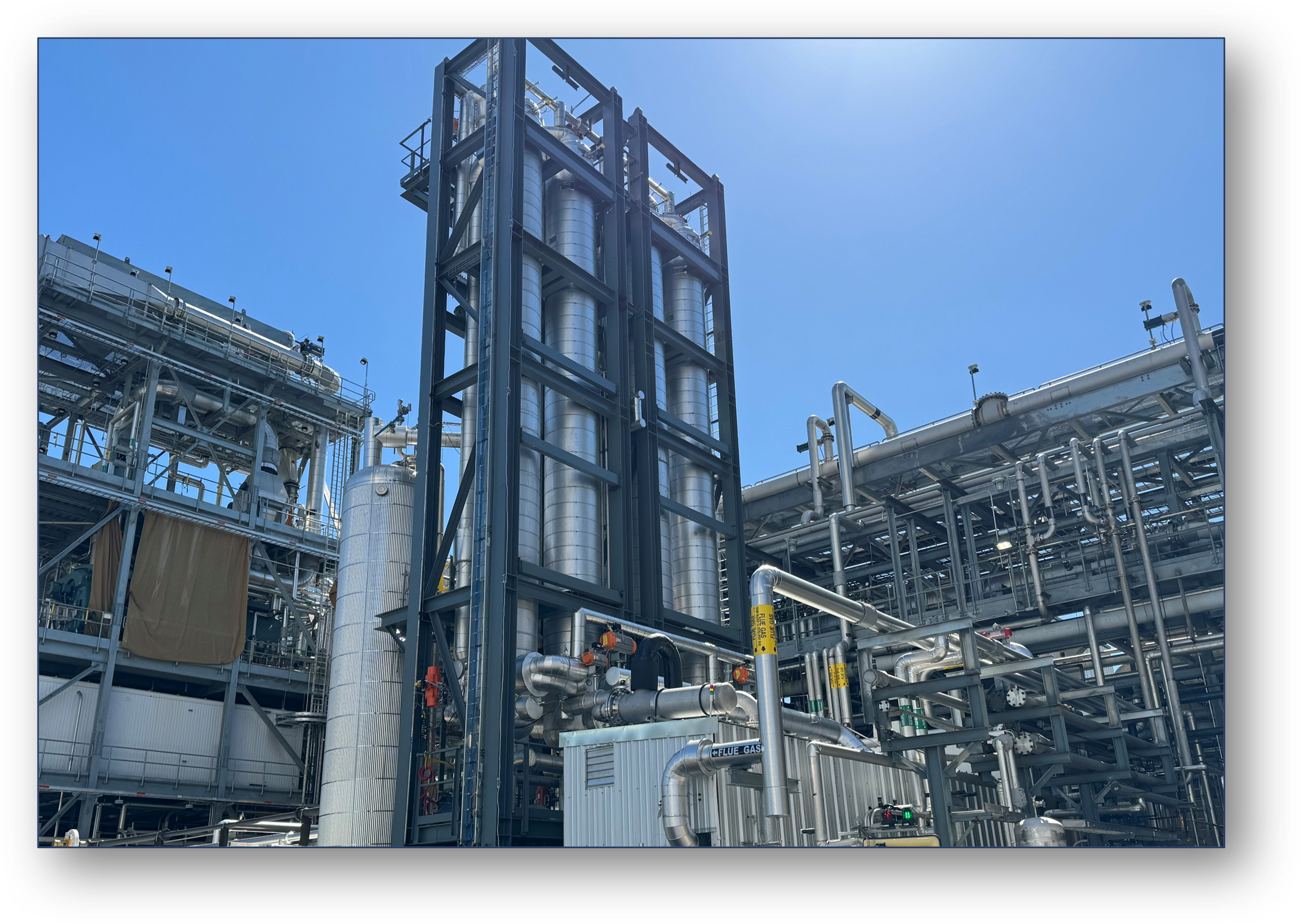
Most carbon capture technologies require complex solvent management, steam regeneration, and continuous chemical handling. FrostCC® uses cold temperatures and standard industrial equipment. That's it.
FrostCC® is a simple, all-electric thermomechanical process that leverages existing equipment types and large global supply chains. FrostCC® compresses, cools, and expands flue gas, causing the CO₂ to "frost" out, transitioning directly from gas to solid in a process known as desublimation. The CO2 deposits as a solid on the heat exchanger surfaces, and the heat exchangers are periodically cycled to melt the solid CO2 into a highly pure liquid. This liquid CO2 can remain a liquid or be converted into gas or supercritical fluid at any pressure with minimal equipment or energy needs. The CO2-lean exhaust gas leaves the frosting heat exchanger and is circulated back through the system as the auto-refrigerant.
The system consists of standardized, skid-based equipment that can be factory-manufactured and shipped to sites for final installation which reduces construction time, complexity, and cost. These mature equipment types include compressors, expanders, pumps, standard heat exchanger types, piping, and valves. No solvents. No steam. No water supply. No external refrigerants. The process can also generate significant quantities of cleaned water for the host site or others.
Process patents awarded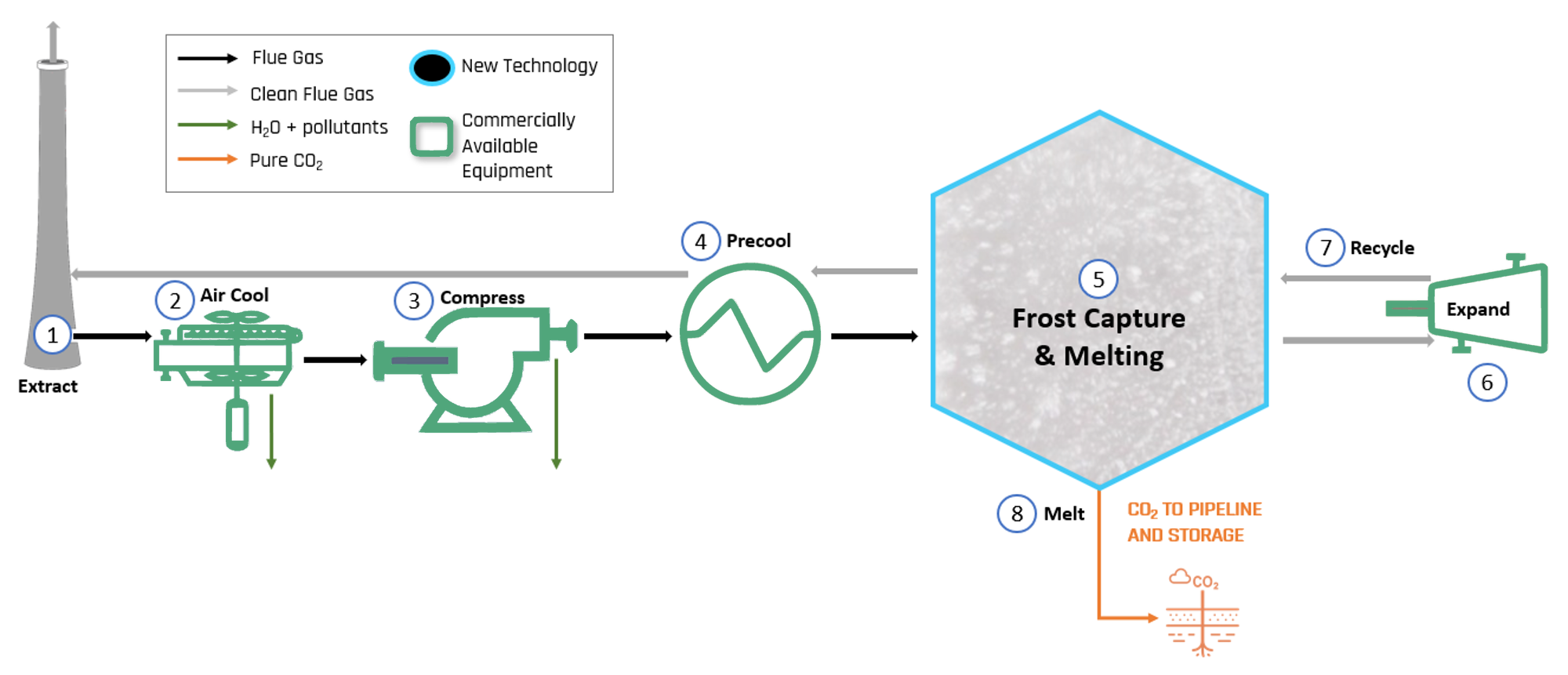
*The ultra pure CO₂ leaves the frosting heat exchangers in liquid phase and can be pressurized to supercritical pipeline pressures with negligible energy — no additional compression, purification, or dehydration required. A gaseous CO2 product can also be delivered with no additional energy required.
WHY IT WORKS
Strength in the Fundamentals
FrostCC® applies established cryogenic and gas-separation principles — the same physics proven for decades in Liquefied Natural Gas (LNG), Natural Gas Liquids (NGL), and Air Separation Units (ASU) — to a new flue gas context. The advantages below are inherent to the process. Because capture is driven by deterministic thermodynamics rather than reaction chemistry, the system is predictable, robust, and built almost entirely from standard industrial equipment.

TRACK RECORD
Validated, Step by Step
FrostCC® was deliberately built on predictable phase-change physics and standard industrial equipment, the foundation of a scale-up methodology engineered for confidence. That design discipline carried the technology from concept to a fully integrated pilot at the DOE's National Carbon Capture Center, and sets a clear, repeatable path from pilot to commercial capacity.

WATER GENERATION
Generates Significant, Clean Water
DEPTH OF VALIDATION
Two Centuries of Modeled Operations
This empirically validated modeling stack, built over six years and anchored by thousands of hours of physical operation, is how FrostCC® scales with confidence. Models are continuously updated with live field data through the FrostDashboard, FrostCarbon's integrated design-and-operations software environment.
FrostCC® is governed by deterministic physics: phase equilibria, heat transfer, and fluid dynamics. These are the same fundamentals engineered with confidence for decades in Liquefied Natural Gas (LNG) and Air Separation (ASU), which is what makes FrostCC® uniquely provable through simulation. Solvent- and sorbent-based capture depends instead on complex chemistry, including degradation, reaction kinetics, and contaminant interactions, whose nuances are characterized through long empirical campaigns. FrostCC®'s behavior can be modeled with precision and anchored by targeted physical testing. Every hour on our test stands validates thousands of hours in simulation.
MODULAR BY DESIGN
Design One. Build One Thousand.
FrostCC® is designed around a modular, standardized train architecture: each train is a repeatable, factory-built unit with consistent performance characteristics. A project deploys as many trains as its capacity requires, whether that means an entire fleet installed at once or additional trains added in stages as a site scales. This flexibility aligns capital deployment with project timelines, reduces upfront risk, and lets capture keep pace with operational or regulatory needs. Identical, well-characterized units reduce integration risk, accelerate project timelines, and ensure predictable performance from first deployment to full commercial capacity.

- Collapse engineering risk into one proven, repeatable template.
- Common basis for EPC pricing, permitting, and performance guarantees.
- Every deployment feeds operating data back into the platform.

- Repetition and scale drive cost-down and schedule compression.
- Fleet procurement improves quality, pricing, and financing confidence.
- Enables portfolio rollouts for hyperscalers, IPPs, and industrials.